by Sanford Baran
This is our first Tone of Life Zoom gathering in the year 2026. It’s wonderful to be together at the start of this very auspicious new year. I was straining to find some significance to the date 2026 or the numbers 2, 0, 2, and 6. Here’s something: If you add these numbers up, they sum to 10. And if you sum those up, the one and the zero, it reduces to the number “one.” So there you have it: 2026 is the year where it’s recognized that everything is one!
In any event, whether there is numerical significance to 2026, or whether the beginning of January is just some arbitrarily mandated starting point in our cyclical dance around the sun, the fact is I can think of no better time to be alive on planet Earth than right now. My overriding sensing at this juncture is of a tremendous expansiveness, both individually and collectively. The call is to actually be that expansion, allowing it to radiate outward through these capacities of body, mind and heart. But to truly answer this call, there is work to be done to strengthen and hone these wonderous instruments so that we’re in position to bring forth the magnitude and intensity of what is surely coming down the pike.
Being fresh in the new year, we’ve entered the season of “New Year’s resolutions.” If you look at the statistics, most people find their resolutions have an expiration date. Research often suggests that about 23% of people quit by the end of the first week, and close to 80% have abandoned their goals by the second week of February. Today is already January 11th so we’re right in that danger zone. For many, the enthusiasm is wearing off, reality is setting in, and that January 1st magic is fading fast.
I personally have never been a big New Year’s resolutions kind of guy. Often, traditional resolutions are about ego-driven ambition or about somehow fixing ourselves, but actually there’s really nothing to fix, at least not from a heavenly perspective. This isn’t to say, however, that there’s nothing for us to do. We’re here, after all, for a reason.
New Year’s resolutions aside, I think it was that disastrous piano lesson I had in the last week of December that spurred me into action. It was a miserable lesson—I had shown up totally unprepared. I tried cramming in some practice a half hour before the lesson, but that never works. On my way home, I felt that familiar sinking feeling; I’d had lessons like this before. It was obvious that I needed to practice more, but without a specific commitment or any real structure, words like “I’ve got to practice more” don’t carry much weight. Left on their own, good intentions don’t stand much of a chance against long-standing habits.
But by the time I got home a new strategy popped into view. Why don’t I try to put in a half an hour of practice early each morning, before I get seriously involved in anything else. This slight adjustment has turned out to be a real game changer. What made all the difference was simply getting my practicing done before I ever go into my office and sit down at the computer. Once I step into that world, the day has a way of taking over, and there’s no telling when—or if—I’ll come back up for air.
So I’ve been doing this now for about a week and a half—an inadvertent and completely unplanned New Year’s resolution. I’m really just getting started, but so far, it’s been going well. I did show up fully prepared for my lesson the other day, which felt like a small but meaningful victory. And I’ve noticed something else too: practicing consistently—showing up every day rather than sporadically—is not only more effective, it’s actually more enjoyable.
It’s interesting this word, practice. If you think about it, we almost always invoke it as a verb—an action we take, a thing we do to improve a skill or avoid mistakes. But there is a much deeper dimension to this word when we treat it as a noun. Think of how we describe a “medical practice” or a “legal practice.” In these contexts, the word isn’t just describing a collection of chores or a list of to-dos; it is the container for a life’s work. A doctor doesn’t just “medical” for a few hours a week; “the practice” is an ongoing, professional commitment to a field of knowledge and a standard of care—it is the steady environment in which they operate every single day.
We can expand this notion of “practice” as a noun to what we might call a spiritual practice. A spiritual practice is not primarily a set of techniques, nor is it a project of self-improvement. It isn’t about aspiring to or achieving a particular state or producing a predictable outcome. At its heart, a spiritual practice is a way of orienting, identifying—a way of living, a way of consistently aligning body, mind, and heart with the truth that is already present. We could say it’s a unique type of container that provides vibrational structure and scaffolding for our work in spiritual service.
Seen this way, a spiritual practice is more like a rhythm—a rhythm of consistency, a rhythm of attention to what really matters, a rhythm of listening to the Word behind the words, a rhythm of showing up and being present. In our experience, we’ve seen over time that these rhythmic pulsations begin to entrain our hearts and minds, permeating all aspects of our day-to-day living—not because we force it to, but because we’ve established a steady cadence that the deeper currents of life can move through.
And here’s the thing: even with rhythm, even with consistency, even with commitment, there’s still a moment-by-moment question that practice itself can’t answer for us in advance. And this question is: What’s needed now? Not in general. Not according to a plan. But here, in this moment, given these unique conditions, what’s needed now?
A spiritual practice may establish the rhythm, but it doesn’t tell mind and heart exactly how to respond once we’re inside the living moment itself. For that, something else is required—a sensitivity, a capacity to sense what fits and what doesn’t as things are actually unfolding.
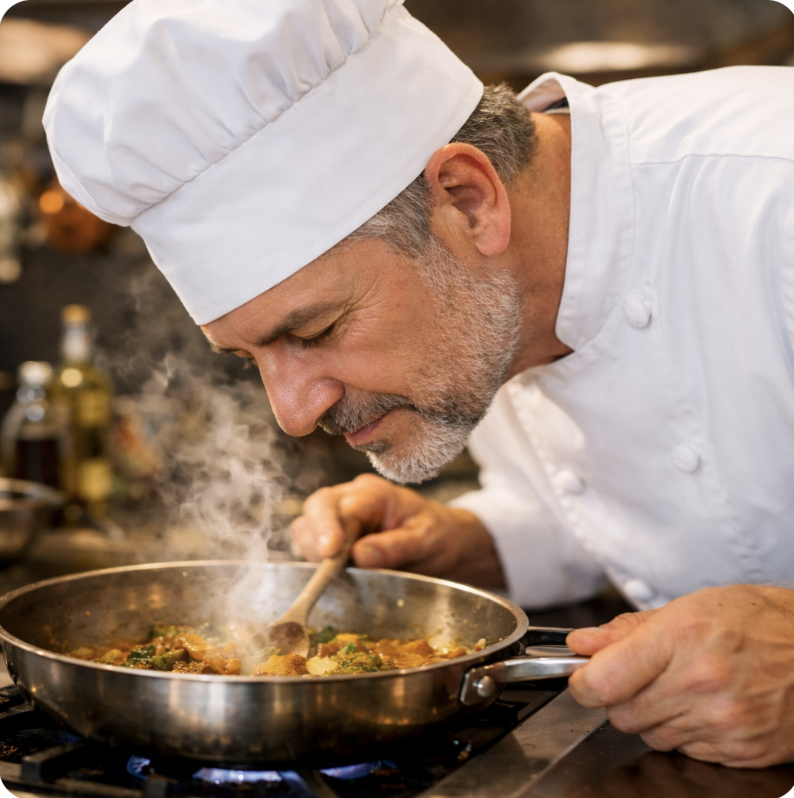
There’s a story about a master chef who’s beginning to mentor a new group of apprentices. Early on, he asks them a simple question: What is the most important piece of equipment in the kitchen? The apprentices answer the way you’d expect: A good set of knives. The right pots and pans. Maybe the stove. The chef listens patiently, and then says, no. The most important piece of equipment in the kitchen is your nose. Because no recipe, no technique, no piece of equipment can tell you what your nose can tell you in the moment. Is the dish ready? Does it need more time? More heat? Less? Something else entirely? The nose is what tells you what’s actually happening now, not what was supposed to be happening according to what’s in the cookbook.
And of course, the nose gets reliable only through experience—through showing up again and again, making mistakes, adjusting, paying attention. Cooking is iterative. You try something, you smell, you respond. Over time, discernment develops.
I love this metaphor because it points to something much deeper than cooking. In any creative or spiritual act, there’s a kind of inner “nose” that must be cultivated—a sensitivity to what’s needed now, given these conditions, these people, this moment. No amount of preparation can replace this. Preparation matters, but discernment happens in real time.
So, the capacity to accurately discern what is needed now turns out to be absolutely vital when it comes to the discovery process itself. Discovery isn’t just about curiosity in the abstract—it’s curiosity guided by sensitive perception. It’s the willingness to explore new terrain, new possibilities, new ways of being, while simultaneously listening for what fits and what doesn’t as we go along.
In this sense, discovery requires what we might call a spiritual nose—an inner perceptual faculty that can sense alignment in real time. We try something. We lean in. We notice. Does this feel alive? Does it open something, or does it contract? Does it have a certain fragrance of rightness—or does it feel off, premature, or forced?
And sometimes we discover very quickly: no, this doesn’t quite work. It doesn’t smell so good. So we step back, adjust, and try again. In this process, other possibilities often emerge—ideas we couldn’t have planned for in advance, directions that only reveal themselves through engagement.
This, I think, is how the creative process actually works much of the time. It isn’t always “Let’s do this”—voilà—perfect on the first try. More often, it’s iterative. But true iteration isn’t random trial and error. It depends on an accurate, aligned, innate internal perception—one that’s been cultivated through practice, rhythm, attention, and presence. Practice gives us the container. Discernment gives us the navigation. And together, they allow discovery to unfold—not as something we control, but as something we participate in, moment by moment.
There’s a wonderful observation by Leonard Bernstein about Ludwig van Beethoven that captures this beautifully. Bernstein points out that when we encounter Beethoven’s music today, there’s an almost overwhelming sense of inevitability about it. The works feel so right, so complete, so precisely themselves, that it’s hard to imagine they could have been written any other way. Every note seems necessary. Every gesture feels ordained.
And yet—Bernstein reminds us—that inevitability is something we experience after the fact. When Beethoven was actually composing, the process was anything but inevitable. His sketches reveal page after page of crossings-out, reworkings, false starts, and radical revisions. Themes were tried, discarded, reshaped, inverted, compressed, expanded. What we now hear as destiny was, in real time, a process of discernment and discovery.
Beethoven didn’t begin with inevitability. He arrived at it.
And how did he arrive there? Not by following a formula. Not by executing a plan with mechanical precision. But by listening—again and again—by sensing what was alive and what wasn’t, what carried force and what fell flat. He kept testing the material against an inner standard, an inner knowing. You might say he was constantly using his nose. As an aside, it might have actually been his nose, as we know he was losing his hearing!
Let’s watch a short excerpt of Leonard Bernstein himself explaining this using as an example the very familiar opening of Beethoven’s Fifth Symphony. https://toneoflife.org/recordings/Bernstein-Beethoven-Fifth.mp4
So this is all very well and good, but the real question remains: What does this mean for us, here at the beginning of 2026? We likely are not composing symphonies. And even if we are, we’re almost certainly not Beethovens. But that doesn’t let us off the hook, because whether or not we work with notes on a page, we are creators. As divine beings in human form, we are continually participating in the creative process—generating substance, uplifting and stewarding our worlds.
What I sense right now is the tremendous potential and opportunity before us. Something is clearly on the move. There is an expanding creative animating force very much at work—both within us and around us. The question isn’t whether this force is present. The question is how we participate in it. How do we individually and collectively be the expansion rather than merely talk about it?
This brings us right back to curiosity, discovery, and practice. The fact is, creation in our own day-to-day living—whether in an actual studio or simply in the ordinary moments of our lives—rarely arrives fully formed. It’s a process, it unfolds. We try something. We listen. We sense. We adjust. Sometimes we get it right on the first attempt—but more often, we don’t. And that’s not a failure. That’s the way creativity works.
What matters is not perfection in the way human beings usually think about it, but responsiveness to what is real. What matters is not certainty at the level of form, but attentiveness to the spirit undergirding everything. What truly matters is the willingness to stay in the process long enough for the perfect vibrational fit to reveal itself. And this is where that inner faculty—the spiritual nose—becomes indispensable. Without it, we either cling rigidly to a plan, an agenda, or wander aimlessly from one idea to another. With it, we can move forward step by step, sensing what fits, what carries life, what needs revision, and what needs to be let go.
So perhaps our work at the beginning of this year is not try to resolve anything once and for all, but to commit ourselves to the practice—to establish the rhythm that allows discernment to that which is true, and to trust the iterative nature of creation itself. To show up. To listen. To revise. And to remain open enough that what eventually emerges may feel, in retrospect, inevitable—even though it could only have been discovered by walking the path one step, one moment, at a time.
Concluding Music
Radetzky March – The Vienna Philharmonic New Years Eve Concert – January 1, 2026
Composed by Johann Strauss Sr. and performed by the Vienna Philharmonic & Yannick Nézet-Séguin
https://toneoflife.org/recordings/Vienna-Philharmonic-NYE-010126.mp4