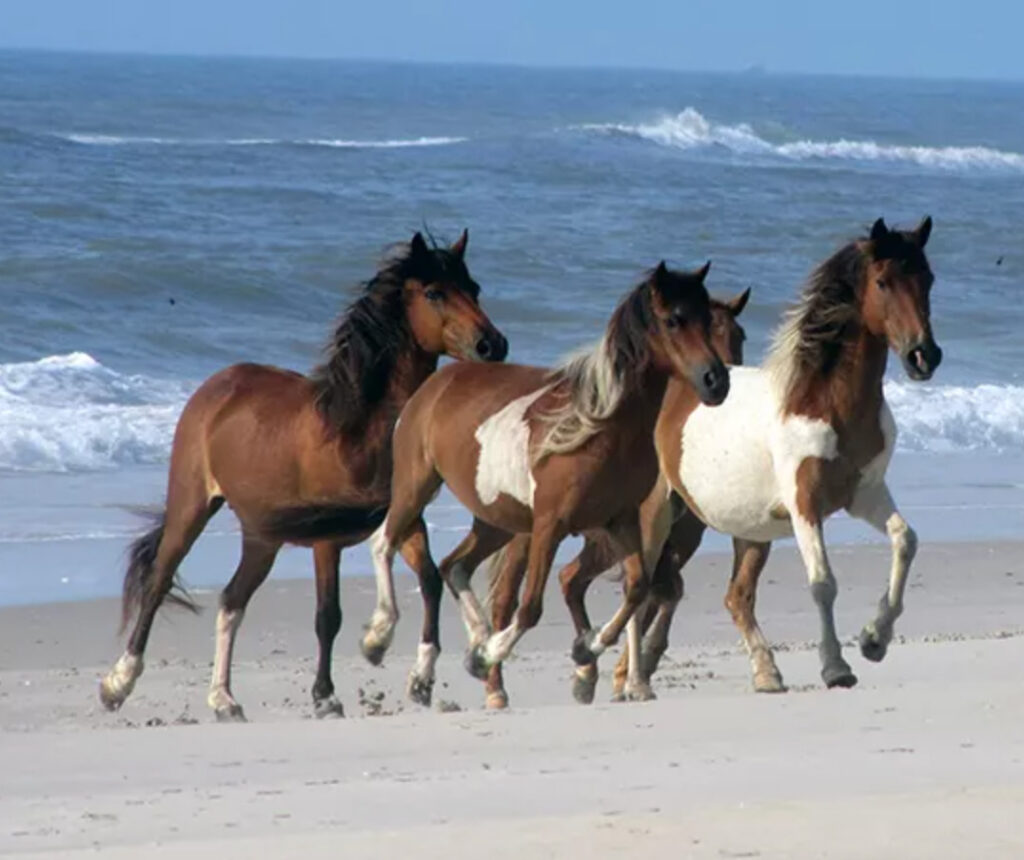
By Christina Pivarnik, Allen Guisinger and Andrew Shier
Christina Pivarnik: It’s always lovely to be together. Good morning, good afternoon, and good evening! Andrew, Allen and I welcome all of you. We’ve been having a great time preparing for this hour together. To begin, we’d like to share some videos with you.
Excerpt of Uranda’s August 5, 1953 class
It’s quite a privilege to have Uranda introduce our time together today! I’m sure we all sense his vibrant spirit with us in this moment. This was an excerpt from a class given on August 5, 1953, entitled, “The Way to Serve—Horse Training.” He used the analogy of training a horse to working with those awakening, emphasizing trust, patience, and confidence. And in his last point, he stressed letting love cast out all fear. Love is always the answer, with both horses and people.
Special thanks to David Barnes for finding not only this transcript, but also the audio for us. When Andrew first listened to it, he made a comment about the tenderness in Uranda’s speaking. Throughout Uranda’s comments to the class, he emphasized the important role horses played in the early days of his ministry; this essential equine essence has continued for decades. I’d like to thank Sanford as well for his artistry in creating the beautiful video with the photos taken over the years of Allen, Andrew, and me with our horses.
Last spring, the three of us decided to come together regularly to talk about the experiences we’ve had with our horses. We call ourselves the “Horse Pod.” Our time over these months, however, hasn’t been to simply talk about horses, but to consider the higher levels of substance that we continue to share with them and how they work with us from attunement to natural horsemanship, to a variety of transformations that we’ve seen in our animals and in ourselves over the years of working with them.
Horses are wise, intuitive, and sensitive creatures. They tune into you 100% and clearly reflect whatever’s going on with their human. Clarity is imperative when working with them. It’s this intuition and wisdom that also makes them excellent attunement partners. There’s a sense that these magnificent animals have served with us since time immemorial, I believe, even before the fall.
They’ve carried and amplified the substance of love with humans to the degree that humans have been open and sensitive to it, and they continue to do so in these current times. There’s an awakening by many around the world about working more with horses in healing in a variety of forms of therapy, from horses who come to hospitals to be companions for those who are ill, to those working with disabilities or PTSD, and much more.
We would like to share a few stories of experiences we’ve had of heavenly horse magic. Stories can be useful to illustrate times of transformation. Often, they’re markers when something brand new opens up in consciousness.
I think I learned to ride before I learned to walk, growing up with horses on our small family farm. When I was 19, I went to a one-month class at 100 Mile House. As I’m sure we all experienced in those early days, it was a life changing, transformative experience, opening the door to fulfilling my and our mission of serving our Beloved on earth at this time. Being in the middle of the Cariboo in BC, in Martin’s home, was an incredible experience on so many levels. I hadn’t yet met Martin, and he wasn’t in residence during class, but I loved hearing all the stories about his ranching on the expansive land that surrounded us. As a bonus to the spiritual awakening I was experiencing at the time, I’d never been on a working ranch before, but I had always dreamed about what it would be like to ride out for miles across the earth.
One night at dinner, I overheard the ranch hands talking about a cattle drive they needed to do the next day, but they were shorthanded and were trying to figure out where to find an extra rider. I immediately volunteered, saying that I’d been riding for years and I would love nothing more than to help them. With my schedule cleared for the day, I rode out the next morning with Sam Dice and Peter Castonguay, along with a couple of ranch dogs. For this young woman, it was a dream come true! After a few hours, Peter and Sam rode off to find errant calves, assuring me I would be fine on my own, that the horse that I was riding knew what he was doing, as did the dog.
So, there I was, alone in the rugged, wild landscape of the Cariboo, with a couple hundred head of cattle in front of me, trusting my horse and the dog to keep them in line. Not another soul was around. I’ll never forget that feeling and that very special day.
By the time we got back late that afternoon, I’d been in the saddle for eight hours straight, and I could barely stand when I jumped off. But that didn’t matter, because I had been blessed with experiencing the most amazing horse I had ever ridden. When I was exclaiming to Sam and Peter about him, they both smiled and told me I’d been riding Martin’s favorite horse. What an amazing gift!
I share this story because not only did Uranda work with horses in the early years, but so did Martin, as he ranched the land around the 100. And no doubt, like Uranda, he used many of the practices of working with horses while working with responding ones. We have a couple of photos of Martin on horseback from his early days, long before my ride on his horse.
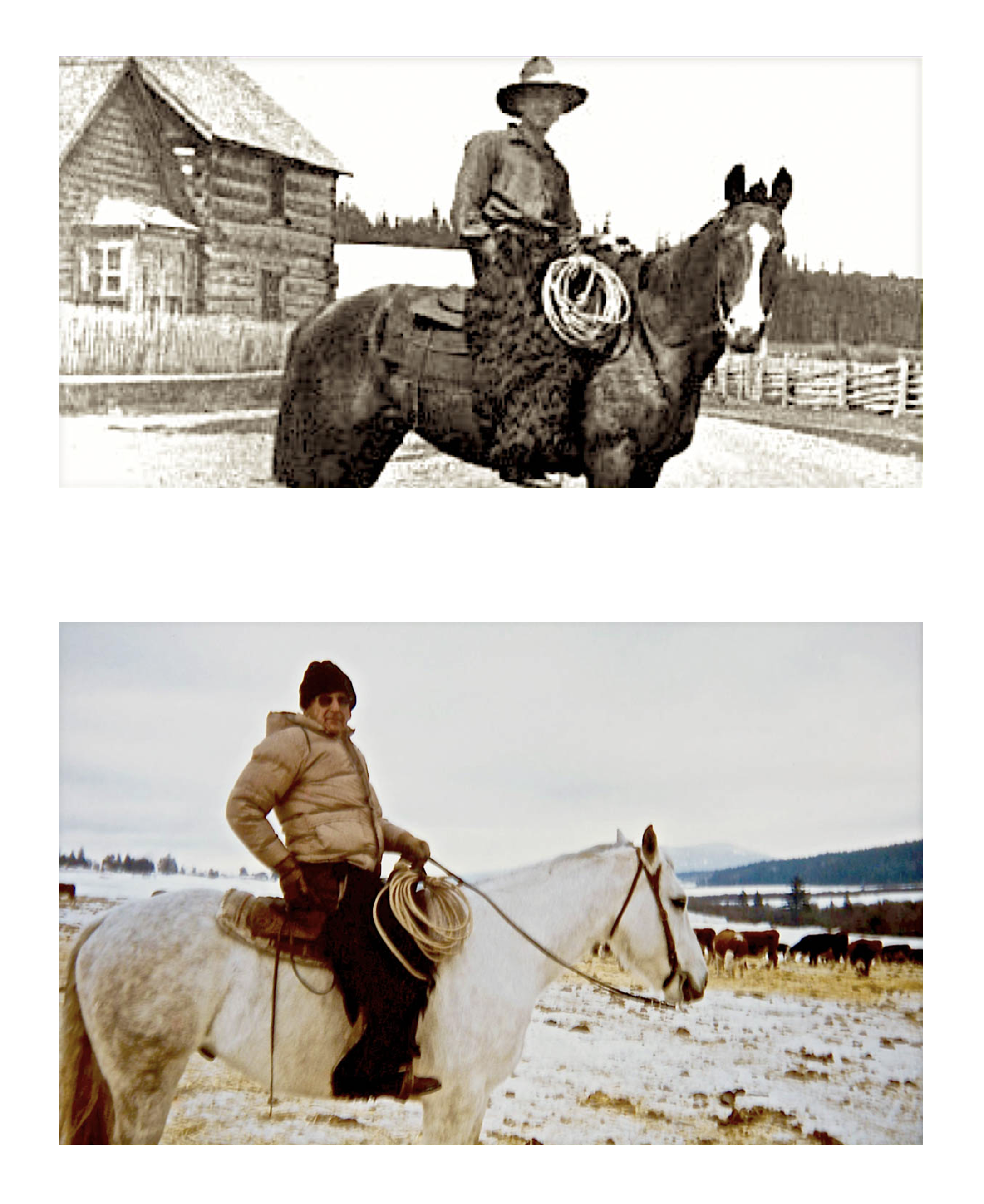
Thank you again to David Barnes, who provided these photos as well.
Years later, I was able to tell Martin this story. He gave me that smile we all came to love so much saying, “Yes, he was a great horse. I’m happy you were able to have that experience with him.”
In whatever way we work with them, these beautiful animals offer sensitivity and patience. Allen, Andrew, and I all do very different things with our horses, but we each share that deep connection of love, through natural horsemanship, honoring their power, their magnificent spirits, their wisdom.
I came across a Native American legend that touched me deeply, and I’d like to share it with you. It’s called, “The Painted Horse of the Wind.”
In the time when the earth still spoke in thunder and the rivers sang the names of those who walked in truth, there lived a horse unlike any other. His name was Tówa-K’aná, meaning “Wind That Remembers.
He was born from the sacred breath of the Four Winds,
Painted not with brushes, but with the hands of the ancestors.
His coat carried stories:
Red for the blood of warriors,
Blue for the voice of water,
White for the bones of the mountains,
And black for the mystery between the stars.
He did not belong to one tribe, but to all who remembered.
Tówa-K’aná would appear only when the people were losing their way.
He came not with noise, but with presence.
Hooves that left no tracks.
Eyes that saw past the skin into the spirit.
The elders knew him well.
They said he could outrun storms and dreams.
They said his mane held the whispers of prayers,
And the shadow taught children how to walk with honor.
One winter, when hunger was strong and hope was fading,
A child named Aiyana stood alone by the canyon edge.
She was the last of her family,
And her tears had run out.
But through the snow came the horse—
silent, warm, still.
He bowed his head, and from the air, a wind rose,
Carrying with it the voices of her people.
Not gone.
Just waiting.
Aiyana climbed onto his back.
And for the first time,
She felt her heart beat, not with fear—
But with belonging.
She returned to her people not as a girl,
But as one who rode with the memory of truth.
And she taught them once more:
“The spirit of the horse is not speed, but memory.
It carries not just bodies, but stories.
To ride with respect is to walk with your ancestors.”
And so the legend of Tówa-K’aná lives on—
In every gust of wind,
Every child who listens,
Every hoofprint that disappears into the dust,
Yet never leaves the heart. (Author unknown)
I love the poetry of this Native American legend and the eternal wisdom of the horse, acknowledging the truth that all is well as we dwell in the holy place.
Allen Guisinger: Thank you very much, Christina and Sanford for that very lovely beginning. As Christina said, Andrew, she and I have been communicating for several months. It’s been a delight to get to know them and to share our completely different experiences with horses. But the one thing that’s consistent is that each of our personal stories are simply examples of translating our inner divine intelligence into action in the outer world through this relationship. We heard that from Uranda in his way of working with them.
In preparing for today, I thought I would give a call to Lloyd Meeker for some firsthand comments about Uranda and horses. (I’m delighted to say I noticed that Lloyd has joined us on this call. Welcome, Lloyd!) He, of course, remembers the big part that horses played in Uranda’s life; he also appreciated Uranda’s training, his learning, and his love for them. Lloyd even remembers the name of Uranda’s favorite horse: Alba. I’m sure that’s the white horse that we saw in the picture. Lloyd may know the root of that name, but in Spanish, in Spain, it means whiteness or brightness. He said he still has the horse blanket in his home in France. Thank you, Lloyd, for the information.
Horses have been a part of my life since a very young age, riding a plow horse bareback, but most of my experiences with horses were in the last 20 years, after my wife and I acquired a ranch. Even before the house we built was finished—we were living in a trailer—we adopted two wild yearling mustangs. As you may know, wild horses are rampant in parts of the western United States. Brought in by the Spanish, they’re considered an invasive species, and there are a lot of them!
The Bureau of Land Management has made efforts to try to have them adopted out, but they can only manage to get relatively small numbers of them adopted. Wild horses are known to be very difficult to train, to tame, understandably. That, however, was not our experience with the two we adopted—a mare and a gelding. We had a wonderful time with them.
We used the same techniques that Uranda talked about. We didn’t know about Uranda’s training, although we did know that was becoming the way of teaching horses. Essentially, it came from our love. Our reason for having this ranch was to have a place where animals were treated with love and care, unlike the way they frequently are in the human nature world. So, we translated that into our behavior with the horses. They were really remarkable!
Mine was named Sinaway. After we had worked with her, in the same way that you saw Andrew working with his horse in the video, one day I said, “I think I can just get on her.” My wife, Mayra, said, “Well, you’d better not.” But I had Mayra hold her with a halter anyway. I didn’t put a saddle or anything on her. I just got on her back. And she never bucked that time or any other time afterwards. She had learned to trust me so much from the love and care we had given her.
Of course, today, Uranda’s techniques are essentially universally adopted for training horses. The old things we see in Westerns are about breaking horses, at least in this country, I don’t believe those methods are used any more.
So, we always focused on love. We had many horses over the years and we always focused on love with them. We didn’t use a bit. That’s a hard metal device that goes in the back of their mouth and it can create pain if not handled right. We never used spurs with them, which cowboys use constantly. We didn’t even put shoes on them because we have pretty soft land. In lieu of the bit, we used a thing called a hackamore, which is a strap that goes around the horse’s muzzle. You can apply a gentle squeeze to ask the horse to slow down or stop when you pull on it, but it doesn’t introduce pain to them.
I don’t ride anymore. I’m almost 82 years old, and I never was a very capable rider, but I just loved riding them around on our ranch. We’ve got a mile and a half of trails, and just to get on that big, beautiful horse and ride gently, maybe slowly canter around the trails, was a beautiful experience. It was really a form of attunement with the natural world.
So today, we’ve got two horses remaining, and two longhorn steers. We’ve got two 28-year-old rescued mares, Pixie and Savannah. Horses normally live 25 to 30 years, but they may live shorter or longer than that. We’ve had Pixie for eight years, but the one I want to talk about today is Savannah. She’s the one you saw in the earlier video on our patio. By the way, we never had one of our horses come on the patio before, but Savannah does! She’ll come to the front door.
We adopted her from the Houston SPCA, which is a wonderful organization. They don’t have much luck adopting out older horses, but that makes room for them to take in another rescue horse. So they were delighted to have us take Savannah, and Pixie eight years prior, but Savannah came to us this year.
We wanted an older horse because it would match more with our age, our potential lifetime. I want to outlive the horses, so this would be their forever home. I hope it will be. Each horse has its own personality, but one thing you can imagine, adopting a senior horse is unique. It’s like getting a 75-year-old child that can’t speak. You don’t know anything about their history. We have no way of knowing all about how she was treated in the first 26 years of her life. But unfortunately, we do know that before the SPCA got her, she was severely neglected by her last owner. I think she was loved originally, but as ownership can change horses, their situations change. Once their original owner passes away, or has to give them up, someone may take over who doesn’t care as well for them.
Horses can be expensive to care for. In any case, Savannah was severely neglected. When they got her six months before we adopted her, she was 200 pounds underweight. She’s a fairly small horse. Her hooves were overgrown, and she’d lost teeth due to starvation. The vet told us that she should never be ridden because of past injuries. Although when I took her to our vet, he said, “I don’t see why you couldn’t ride her.” But we don’t ride anymore, so that’s a non-issue.
Under the SPCA’s good care, and they’re really a good organization, she had regained most of that weight and has really filled out with us. She’s very healthy and happy now. The good news is, the reason I know she was at one time loved, ridden and cared for, is that she has excellent ground manners. That means that she readily accepts lifting her hooves for trimming, loading into a trailer, putting tack on her.
But Savannah would not let us catch her in the field when she first came here. She wouldn’t come up to us. She was nervous and afraid. That’s all changed with the love that we’ve given her, following guidelines similar to what Uranda used. We’re obviously not training her to ride or do tricks or anything like that, but just to love her. And as with Pixie, we take care of both of them every day. We brush them, we give them baths. In fact, yesterday I gave them both a bath so they’d be in good shape for this session today! They thanked me by immediately rolling in the mud after that. It’s amazing how they can clean themselves off, rolling in grass after that.
So, the beauty is that Savannah, after this time, has become very accustomed to us. She’s not perfect, but she is a totally different horse now. We let the horses come up by our house, as you saw in the photo. She gets on the patio, even though they’ve got a 40-acre pasture. They come right up to the house and hang out here with both of us. She’s usually the first one here.
Horses need to be worked with. I’ve worried about these two horses since I don’t ride them. I’m worried that they don’t get enough care. As Christina was saying, they like to be worked with. They like to be with humans who treat them fairly and with love. I like to take them for walks. I’ve done that with my other horses in the past. But anytime I would take another horse on a long walk, I had to have a halter and a lead rope on them. If I didn’t, they would run off into the fields or run back to the barn. After the first walk with a halter with Savannah, and then a second walk, I just took the lead rope off her. And she went along with me, with her head by my shoulder or maybe slightly behind me, for a mile and a half walk. She never ran back. And that’s the way we’ve done it ever since.
This is a unique example of what I think is success in using love, patience and care for this horse. She’s going to have a good rest of her life with us, however long or short it may be. It’s been a beautiful experience of trust.
Andrew Shier: Wonderful, thank you, Allen and Christina! I’ll start by saying how touched I am to be in everyone’s presence today. It was wonderful seeing all of you in the check-in earlier and knowing from whence we come. Very full. I have to bend a knee to Allen and Christina because my experience with horses is quite short in comparison.
Thirteen years ago, I had a rope in my hand, and at the other end of it was a thousand-pound horse. I hadn’t spent that much time with horses; I’d ridden a couple times at Sunrise Ranch, but that was about it. The picture where you saw me on horseback was taken about four years ago when we went to a dude ranch in Arizona. Those were trail horses and I felt very safe.
My learning curve has been quite steep. My horse was two or three years old when she came to us. One day my wife, Peri, came home and said, “Andrew, I’d like to get a horse.” So, we adopted the two horses we have now.
I needed to learn how to train the younger horse. She was wild and needed training. We hired a trainer who also trained me about how to be with her, and that was quite remarkable. I know enough about myself that I can say (which I had to say when I was holding that lead line to that thousand-pound horse!), is “for this cause came I.” I knew upon saying that, that I would be shown how to do this.
So, I just kept letting go, kept up with training, and did the best I could. I moved from great fear to flow, to learning how to be with this horse. She was very generous, but she was also very feisty, rearing and kicking. So, I had to learn how to be with that, and that was a remarkable experience. My trainer was fabulous. I had a turning point moment. Actually, I had a couple of them.
One was in the middle of the night. The full moon was out, Peri was traveling, and I heard the horses out in my yard. They had gotten out. At this point, I knew very little. So, I grabbed a rope. I didn’t even know how to put on the halter and didn’t know how to attach the rope to it. So, I wrapped the rope around the neck of the lead mare (there is a lead mare, and then there’s the one that follows). I just wrapped that rope around her neck and got her into the paddock somehow. The other one followed her, and I closed the gate. I was high as a kite! I thought to myself, “Wow, you did it!”
You know, love casts out all fear, where too much fear can’t be accommodated. Anyway, I got out the lawn chair with the full moon above and I just sat there. I was just so happy.
Then things gradually began to shift in me, and I developed quite a relationship with this horse. I had learned a bit and then added more technical skills. I’m very thankful for that.
At one point, I had a little bit of performance anxiety. I realized my trainer was watching me; Peri was watching me, and, you know, I was trying to put on a good show. I looked at my horse and I heard her say, “Andrew, just be yourself.” And as I say it right now, I’m getting goosebumps, because it shifted everything. I finally began to relax, and I think my heart opened. My heart just went wide open. And that connection, well, I can feel it right now. That connection shifted dramatically.
When I think of my journey, it’s a bit opposite from Uranda’s, in that I learned how to work with people first through my attunement work. I guess you could say people come wild. Actually, you know, we all have PTSD to some extent. Our nervous systems are on overdrive, and a client comes to me, lays on my table, and there’s a lot going on. But when you work in the cervical pattern, and that vesica pisces opens, it’s a beautiful experience. Then heaven lands, the front door opens, and you’re in a different level of pneumaplasm.
That’s what I began to experience with my horse: the energy, that level that Rumi speaks of, helping you with the idea of wrong doing and right doing. There is a field, and when you enter that field you can barely talk about it. That began to unwind in me. And then it was very, very different. You’re in a flow; it’s all energy. It’s all about proximity and body language. It’s not using a whip, although you saw I had a piece of bamboo in my hand, but not a whip. It’s about body language and how you read your horse and adjust yourself relative to that. Then it’s a phenomenal flow and that’s a great blessing.
Peri and I live on a 55-acre tract of land. I’m so aware of the part that horses are playing here. These are great friends. They’re so integrated into what this place is. They’re a part of it. There’s communion. And it’s not a separate thing. I began to become aware of how everything is integrated and fits together. These horses create manure. Manure is on our field and I make compost with it. I grow vegetables. It’s all part of the whole.
My daily routine is coming out every morning to be with the horses, clean up after them and start my day. And I insist with my horse, Aponi, on a hug first before she can eat her hay. She’s used to it now. She’ll come up and stop several feet shy of me. Every now and again, she’ll say, “Andrew, enough, enough. Okay. Just let me, let me get to it.”
I’m thrilled with the awareness of simple things, and living in this world where we’re privileged to live on this beautiful land. When people come here for attunements, they feel it, too. Many people have asked, “But what is here?”
One last story. Horses love us and they want the real you, the authentic you. Sometimes, I have to raise my voice, though. As Uranda said, they don’t always know what to do, they need training. They need to hear, but not in an angry voice. One day I was sharing an attunement with a client and the window in my office was open, looking out on the paddock. The horses were in the paddock and I heard this noise. I looked up and they were kicking at each other and rearing. I said to my client, “Excuse me for a moment.” I walked outside and I said to the horses, “Knock it off!” And sure enough, they separated. Those ears came forward and that was it. But I thought to myself, we’re at that level of beauty and communion.
I’m thrilled to be with you and have this time together.
Following Comments…
Christina Pivarnik: It’s always good to get back up on the horse when something’s happened. It’s a great analogy for many things in life. What a wonderful time to share with all of you. It’s been great to welcome you into our Horse Pod and to realize the impact these animals have in our lives. What we honor today is the partnership with animals, specifically horses, and the substance generated from that connection. This is the natural world of stewardship.
Allen Guisinger: It’s been a joy getting to know these two people. I’ve noticed in the last few years, each time we get together on Zoom, we get a chance to have a deeper connection. It’s the strength of our unity that we have in this body. I look forward to continuing in our Horse Pod with these two individuals. And I know others would be welcome to join us. If you’re interested, reach out to Christina. Thank you all very much; it’s been a wonderful time.
Andrew Shier: I would echo Allen’s words. I was deeply thankful for the triad that the three of us shared for many months. That was quite a privilege. I was also deeply touched at the check-in at the beginning of our hour. I feel honored to be in your company today. I don’t take that lightly. And I know from whence we come and where we meet in the tone, the Tone of Life. From that standpoint, we are great friends. Thank you.
Christina Pivarnik: Thank you both! What a privilege to work with these two remarkable men for the past months and how lovely to share it with all of you, to see your smiles and know your spirit, your substance, that is present this morning.