by Bill Isaacs and Volker Brendel
Bill Isaacs: In this moment we have a remarkable vessel for letting the light shine. There have been countless cycles of history stretching back as far as human beings can see that have been setting the conditions for the emergence of an experience that allows the light to shine. Our ability here—to the extent that we actually exercise it—did not just arise unaided. It is the fruit of a very particular thread of history stretching back centuries. This thread, woven by life, has sought to bring conscious awareness again into the field of human experience. You might think, observing this now, that it does not seem like much. But that would be too limited a view. There have been relatively few containers for the emergence of conscious Being. When they do arise, they carry immense power and far-ranging impact. Coming to see the significance of this radiant stance, and more, to actively participate in it, is one of the great tasks of this age.
The great red dragon continues to crash around in the heaven of human consciousness, frightening people into submission and obedience. Its seven heads, with its seven crowns and ten horns, embody all manner of appetites and distorted channels of expression within the body of humanity. These past few years have seen some moderate upgrades to the heads of the dragon. Social media is a new head, pumping out all kinds of noise and distortions, blotting out the stars, obscuring the light.
As the knights of old knew, you slay the dragon by calling it by its true name. In other words, you shine the light. Ultimately this is a remarkably simple act. When fear no longer dominates, and the light shines, the dragon is quickly banished. This is what Canadian Prime Minister Mark Carney did at Davos a few weeks ago in his speech at the World Economic Forum. The theme of the conference this year was “A Spirit of Dialogue,” which people wryly noted was not exactly an accurate description of what was going on. Carney reportedly stunned the assembled crowd this year by naming some uncomfortable truths. He quoted from a remarkable essay by Vaclav Havel called, “The Power of the Powerless.” Havel was a Czech playwright and dissident who became president of then-Czechoslovakia.
Carney quoted the example Havel wrote about in his essay of a greengrocer who every morning places a sign in his window that says, “Workers of the World Unite.” Carney says the greengrocer…
“…doesn’t believe in it. No one does. But he places the sign anyway to avoid trouble, to signal compliance, to get along. And because every shopkeeper on every street does the same, the system persists—not through violence alone, but through the participation of ordinary people in rituals they privately know to be false.”
Havel called this “living within a lie.” He went on:
“The system’s power comes not from its truth but from everyone’s willingness to perform as if it were true and its fragility comes from the same source. When even one person stops performing, when the greengrocer removes his sign, the illusion begins to crack.”
The feeling of powerlessness is not new. It recurs throughout the human condition. Victimization is a habit. Even people in so-called positions of power often feel quite powerless. I’ve spoken with many leaders over the years who have claimed precisely this. They note that while people imagine they have a lot of power, CEOs and even prime ministers will say, “But I cannot do much.” What is this phenomenon of powerlessness and why is it so pervasive?
Carney, as a head of state, challenged this view. He was responding to tectonic shifts in the geopolitical landscape that have upended the rules-based order that has prevailed for the past 80 years. He gave voice to the anxieties many leaders have had. He called for people to take the sign from out of their window and to admit that a different order is unfolding, and that they were not in fact powerless in the face of these changes.
Carney went further. He said that the order that we have been living with over the last 80 years has not just changed but broken down, “We are in the midst of a rupture, not a transition.” While this is most certainly true, the rupture goes far beyond geopolitical factors and states vying for dominance. While Carney was thinking of this in terms of the geopolitical order, institutional failure, and the rising tide of authoritarianism in the great power countries, the breakdown is really much more profound. There is a crack in the entire edifice of the human nature system. What was fascinating, and encouraging, was the level of response to Carney’s words. Carney received a standing ovation at Davos and his words have been echoing around the world for some weeks now. The resonant chord he struck points to something important.The willingness to face facts turns out to be liberating and empowering, not a cause for fear.
Carney was pointing to the opportunity in these moments of so-called breakdown to find a new path. What I see in this is a much wider emerging acknowledgement of the power of what Havel called “living with the truth.” Havel notes in his essay that putting up the sign is like saying, “I’m afraid and therefore unquestionably obedient.” People do this because they collude with a system that represses them and deceive themselves about their collusion—what Havel rather brutally called, “the low foundations of their obedience.” They think that by going along they will be safe. They will not. While Havel and Carney were speaking about political systems, what people are actually doing is denying the truth of themselves, the source of their own life. That is truly dangerous. Havel was aware of this. He says in this same essay that…
“…under the ordinary surface of the of the life of lies there slumbers the hidden sphere of life in its real aims of its hidden openness to truth. The profound crisis of human identity brought on by living within a lie…is a deep moral crisis in society.”
Havel says we need…
“…a radical renewal of the relationship of human beings to…the ‘human order,’ which no political order can replace. A new experience of being, a renewed rootedness in the universe, a newly grasped sense of higher responsibility, a newfound inner relationship to other people and to the human community, these factors clearly indicate the direction in which we must go.”
Havel wrote these words in 1978, calling not for a political revolution but for people to find a realignment with the truth. This could come across to some as quite abstract, leading them to wonder, “What are you going to protest against then?” But the courageous response is, “I’m going to stand still.” There is a way out of the ruptured state. That is what is exciting: there is not just a willingness but a hunger to discover what this means.
What does it mean to live within the truth? It doesn’t take much to recognize that life is endeavoring to bring creative order into one’s own life. The difficulty has been the degree to which everyone has been involved in the battle of resisting it, contending with the dragon. That resistance continues but increasingly we learn to transform it within ourselves. We do this by taking the sign out of our own window, meaning we face the fact of our tendencies to live within our comfort zone of playing small, and stop accepting an identity that is anything other than the truth of ourselves. It’s not the factors of resistance and self-disempowerment in other people’s consciousness that matter; it’s our own. The fascinating job now is allowing the so-called comfort of living in a powerless state to dissolve. Human beings have been caught in an anesthetizing collective comfort zone. “We’re powerless. That’s how it is. Things are unfolding the way they do. You can’t do much about it.” Carney shined the light on the lie that this is.
To step past the lie and live within the truth could be dangerous, like poking your head up the parapet. It seems to be safer to maintain the stance everyone else has, that one cannot do much. But this is only true if one is still battling with the dragon. Shining the light, the struggle dissipates.
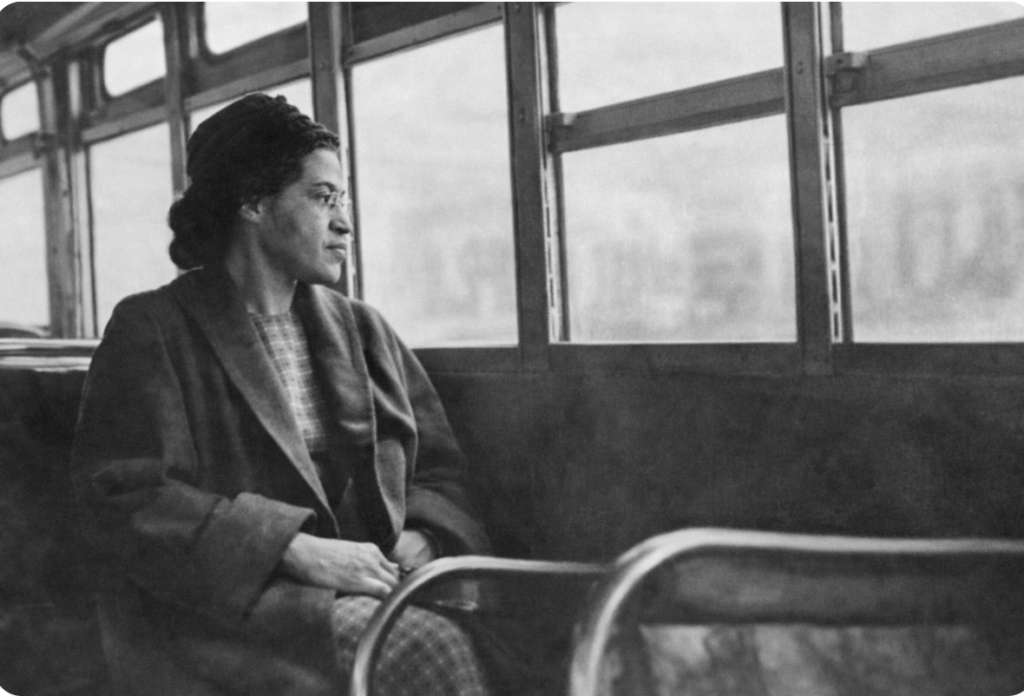
We celebrate the emergence of this when we see it. An excellent example shines through the story of Rosa Parks. Despite the myth, her feet did not get tired when she refused to give up her seat on a bus in Montgomery, Alabama in 1955. That cold December evening, she was seated in the so-called “no man’s land” where white and black could sit when the bus driver asked her to move. She refused. People imagine that great acts of leadership involve making great speeches or fighting great battles. And at 6:00 she was sitting in her seat. And at 6:01 she was still sitting. There was no outer movement at all. As she later put it,
“I felt that it was not right to be deprived of freedom when we were living in the…home of the brave, and the land of the free. And I refused to stand up on the order of the bus driver…for a white passenger to take the seat…I was not sitting in the front of the bus, as so many people have said, and neither [were], my feet hurting, as many people have said. But I had made up my mind that I would not give in any longer to legally enforced racial segregation.”
She decided to act the way a free woman would. The change was in her consciousness. In other words, she decided to live within the truth. This one simple act of refusing to give up her seat has resonated for the seven decades since.
Living within the truth puts us into connection with the power of the whole, which is organizing everything everywhere. It’s immense. Learning to be functional within the flow of the power of the whole is the true positioning of human consciousness. The fact that it’s been abandoned for however many centuries is beside the point. It needs to be brought now into form, brought to focus now through me.
One does not really need, nor does one ever get a preview of the impact that emerges as a result of one’s radiant action. It is all part of many centuries of the unfolding creative process to finally allow a point of focus to emerge. And here we are. And now we can see the wider patterns of leadership endeavoring to point out the lie that has captured human consciousness. The light is shining and the dragon is being cast out. A point of focus for this is adequately present if we assume responsibility for it. And the results appear.
Volker Brendel: Thank you, Bill. You articulated a vast and accurate perspective, born out of your living experience—as I know from my own personal experience of our friendship.
As you were telling the story of the greengrocer in old Czechoslovakia, I suddenly had the vision that perhaps, at the time, I might have had the inclination and the guts to put a slightly modified piece of paper into my shop window. It would have said—in the same style and typeface—”The workers of the world are united,” and then, in small print, “and so is everybody else.”
It is interesting that the great religions and political movements of the world, at their core, all strive toward the same goal: a society where everybody acknowledges their oneness, and the usual strife and fighting are no more. Even more interesting is that all these efforts have failed because of that very noble ambition to change everything, according to our superior plan, with the idea that to get going, everyone just needs to follow “our brilliant path” to reach that goal.
One of Bill’s and my common mentors likes to say—quoting his father—that the notion of a leader being tasked with taking their people out of the wilderness is mistaken. “No, no, no,” his father would say. “The task is to get the wilderness out of the people.” In other words, induce a change in consciousness.
The topic of power is, of course, interesting and pertinent. I recall a scene from my Oxford days. I know our friends Yujin Pak and Bruce Allyn were part of that scene. We had a visiting speaker—a big shot from California in the New Age movement. He had invented some improvement seminars that Yujin was particularly enthusiastic about and thought this thick‑headed German friend of his should definitely take to loosen up a little bit.
This fellow had, at least on the surface, a very big ego, as well as great financial success. Coming from California, one of his famous lines was, “Don’t worry—as long as I’m in the building, there will be no earthquake.” He had even started an initiative to end world hunger within a few years.
We were walking with him down the streets of Oxford, and he was pushing the theme to us of, “You’re young guys. Don’t you feel powerless? How do you plan to change the world?” He received only bemused smiles from us. Even then, we had touched the representation of the truth—in this case through the Emissary communities in Mickleton and elsewhere— which exemplified the very thing you’ve been talking about, Bill: knowing the truth and knowing the power of the universe that is running everything.
So even as young and ignorant as we were at the time—at least speaking for myself—we did not feel powerless in the least. We felt our lives were given by this one power, and that it provided everything we needed to do what was to be done. And I don’t think any of us has looked back from that insight.
A lot of people think power comes from being connected to the right people, being in the right networks. These days you cannot open a news site without the latest updates on someone who was the hub of such a network. (I won’t name him, but everyone knows who I am talking about—a sexual predator with an astonishing web of connections around the world.) While sexual predation is the theme presented, the network was far beyond that. It was a so‑called power network of money and influence, connecting a whole range of people.
Of course, it came tumbling down eventually, and the fallout continues. But while such things unfold, people feel attracted to these networks because it looks like that’s where power is—where deals are made. But it is a very poor substitute for the network that life already provides.
To give an example: Sanford and I—and also Cliff Penwell, whom many of you know—had the privilege of working with Bill and some other friends in West Concord in December. At some point, Bill asked the group of seven or eight of us, “What brought you here? Why are you here?” We gave different answers, ranging from, “Well, I took a plane,” to “Bill called me up,” to “I had nothing better to do.”
But the deeper reality—and it came through Bill’s humility—was that Life put this together. There is no way Bill or anyone else could have said, “Let me see, we need an ex‑military man, a guy from Australia, an old guy from the civil rights movement, a software engineer, a young guy, a coach, and a scientist. Whom do we have in the Rolodex?” Something much larger was in motion—and still is—which is Life itself.
And if you don’t relate to that example, consider this gathering this morning. Who put it together? Did anyone here make a list and decide who should be here? No. Something else did—Life.
A long time ago in our training, you probably all heard the beginning of Psalm 127 quoted as, “Except the Lord build the house, they labor in vain that build it.” Poetic language, yes, but true. Whether we are building a house, an organization, or our schedule for next week—unless we let the one power that animates everything have a say, there is no real power.
There may be a substitute for a while—influence, money—but is that real? Maybe temporarily. What’s real is what Life itself puts together.
Once we have this conviction—and I’m sure many of you have the experience—it becomes inseparable from us. It is not something we strive to attain; it is a fact. And once we are in that position, whether what we build is small or large, the principle remains the same. We can relax, knowing this, and proceed.
So, thank you, Bill, for stimulating some anecdotes and insights. It is an absolute privilege to be with you today and in another context these days, because you know what you’re talking about from experience. And Sanford does, and many of you do. It is marvelous to see what Life wants to create—so much more powerful, and so much more exciting than mind creations.
Bill Isaacs: The most direct manifestation of power in human consciousness is friendship, which arises from agreement in the truth. I very much appreciate the gift of that direct experience of friendship that Volker and I have had over many years. How much more work there is yet to do, to carry the fullness of that responsibility. While we may trust that this is adequate for the moment, it’s certainly clear there is much more to go.