By Sanford Baran
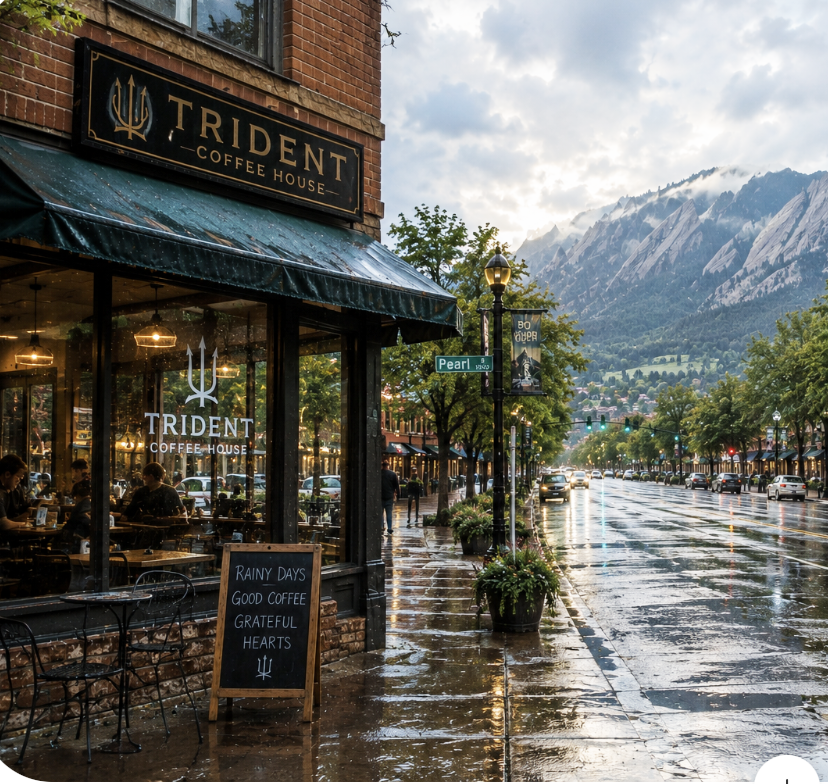
It’s been unseasonably dry this past year in Colorado, compounding the ever-present drought now quite commonplace throughout the U.S. West. A few weeks ago, on a hot Boulder afternoon, I was riding my Honda 50cc motor scooter to my favorite coffee shop downtown when I saw an ominous bank of dark clouds gathering over the mountains. Afternoon thunderstorms are part of the summer rhythm here: the sky darkens, the wind rises, and suddenly the whole atmosphere seems charged with possibility.
You never know if these storms are really going to pan out, but if this one was going to happen, I was hoping to reach the coffee shop before getting caught in it. I made it—just barely. Five minutes after I stepped inside, the sky opened, and water came down in sheets, pounding the pavement, overflowing the gutters, and transforming the street outside the window. Almost immediately, the lights in the coffee shop went out. For a couple of minutes we sat together in the dimness, listening to the rain splattering on the sidewalk and street.
Then the lights flickered back on. People looked up, smiled, and began talking with one another across the room. The shared feeling was unmistakable: this was wonderful—so cooling, so cleansing, so deeply refreshing. And as I watched the rain, a thought arose in me, immediate and unbidden: what a blessing!
Almost as soon as that thought appeared, it opened into two questions, an outer one and an inner one. The outer question was about the rain itself. Where did all this water come from? Not simply where had this particular storm come from, or how moisture had gathered in the atmosphere above Boulder, but where had water itself come from? How had this extraordinary substance—the substance now rushing along the curbs, darkening the pavement and cooling the air—come to exist in the first place?
And then the inner question, quieter and more intimate: where had the blessing come from? For now, let’s leave that inner question open and tackle the easier one first: the origin of water.
Without water, life in the forms we know simply could not exist. Every cell, every heartbeat, every thought passing through a mind right now depends on this one particular substance. So the question of how did water come to be isn’t idle curiosity; it’s closer to asking after the origin of life itself.
I’d like to tell you a creation story now. I don’t pretend that this story is the definitive story—it happens to be the one told by telescopes and spectrometers. I ask that you listen to it the way you’d listen to any creation story: not getting too distracted by the various mechanisms and processes described, but for what the story reveals, the magic of creation.
In the beginning—at least the beginning the way cosmologists envision it, in those first few minutes after the universe came into being—there was hydrogen. Almost all of it that will ever exist in the universe was made then, before there were stars, before there was a single planet anywhere, before there was a “somewhere” to speak of at all. Hydrogen, the lightest element, the simplest atom, is the oldest thing here this morning.
But hydrogen by itself is not water. It took something else, something that hadn’t been made yet, and wouldn’t be made for a very long time.
Stars gathered out of that early hydrogen, pulled together by gravity—the weakest of all the forces, and for that very reason, the most patient.
Deep inside stars like these, sometime in that long stretch before our own sun existed, under pressures we can barely describe or fathom, hydrogen began to forge itself into heavier things. Carbon. Then oxygen. But a star doesn’t give this up easily. It has to die first. It has to collapse, and tear itself apart, and scatter everything it spent millions of years building—flinging that oxygen outward, which then spread, slowly, over hundreds of millions of years, far and wide throughout the Milky Way.
Hydrogen and oxygen: two entirely different histories. One almost as old as time itself. One born in the death of a star. And somewhere, eventually, they find each other and meet—not hydrogen anymore, not oxygen anymore, but forming something else entirely.
That meeting, however, didn’t happen here. Not yet anyway. Our own young Earth was too hot, too close to our sun, for water to survive here even if it had arrived. So it had to be carried in—locked in ice, riding inside comets and asteroids, delivered collision by collision, over hundreds of millions of years. An impossibly long, unglamorous, unwitnessed bombardment. Nothing about it was gentle. And out of that violence: oceans.
A story billions of years in the making. Scientifically speaking, none of it had to happen—each step could so easily have gone some other way. And yet, standing here, looking back at it now, something in me doesn’t experience it that way. It doesn’t feel like it could have gone any other way. It feels like something that was inevitably going to arrive, eventually, at exactly this.
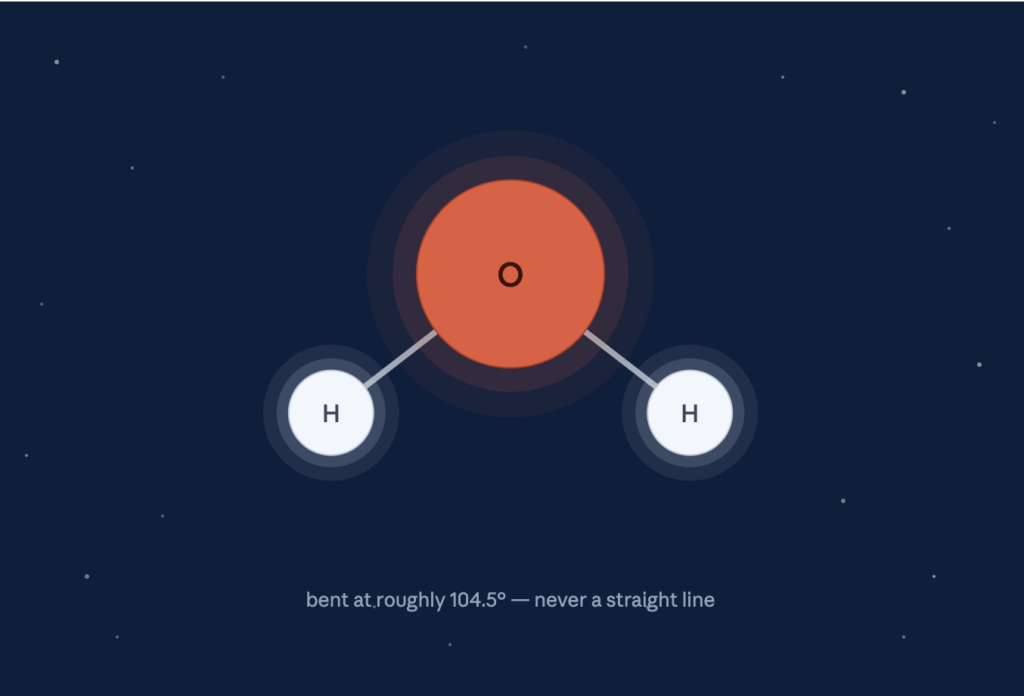
Let’s now come back down to something on the opposite end of the scale—so small that even our best instruments can only catch it frozen, motionless, colder than any winter on Earth. A single molecule of water. Let’s take a look at a graphical rendering. Two hydrogen atoms, one oxygen, joined not in a straight line but bent, a small angle, almost like a boomerang. That bend turns out to mean almost everything.
Because of this shape, water molecules reach for each other. What do I mean by that? One side of the molecule, where the oxygen sits, carries a faint negative charge. The other side carries a faint positive one. And what’s oppositely charged reaches for each other, over and over, molecule after molecule. Strangely, what that reaching creates doesn’t come from the molecule by itself. It comes from the pull. From what all that pulling adds up to: not a substance made of separate parts, but something closer to a community, acting as one.
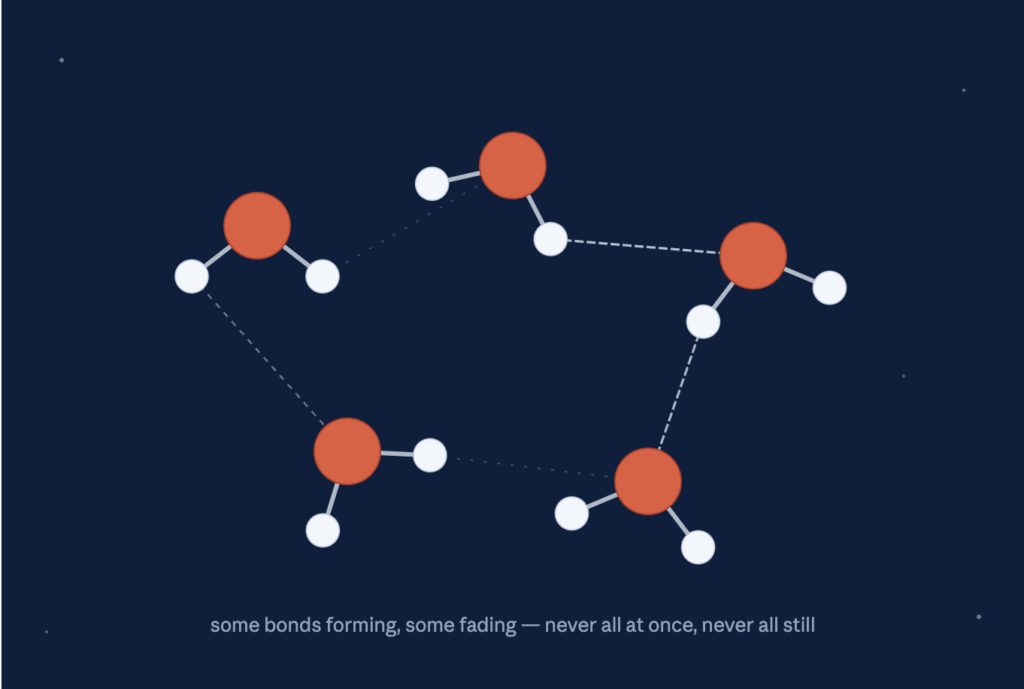
And this is what that reaching actually looks like. Not one molecule. Many. Each one still itself, still complete, and still leaning toward its neighbors. The pull between them is real. But it’s gentle enough that the ordinary jostling of molecules at room temperature keeps breaking these bonds apart, and reforming them, again and again. Apart. Together. Apart. Together. A trillion times a second, in every molecule, all at once. No single bond here is permanent. Every one of these connections is real, and every one is provisional.
This constant letting go and reforming is exactly what lets molecules slide past one another, nothing holding any of them rigidly in place. That sliding is flow, the very thing your skin knows directly when water moves across it: molecules mobile enough to coat, to cling, to slip between your fingers, rather than to hold a shape of their own.
Here’s something worth naming, without trying to explain it: when one molecule bonds well with its neighbor, it doesn’t just add one connection to a tally. It actually strengthens all the bonds around it. Each good bond helps the next one hold.
And here’s something else: a single molecule of water, entirely alone, is not wet. Wetness isn’t hiding inside one molecule, waiting to be noticed. It only comes into being once many molecules are free to slide against one another.
But that lone molecule was never empty, even by itself. It was already carrying everything we just walked through: hydrogen from the universe’s first minutes, oxygen from a star that had to die, already whole, already carrying its own whole story, and yet still unfinished. Not because anything is missing from it, but because of what it can become—liquid water. Flow, fluidity, wetness only happens when a community of water molecules forms.
Without that reaching, without a wetness that lives between molecules, never within just one, life as we know it, could not exist.
So, hydrogen from the universe’s first minutes and oxygen from a star that had to die. A shape bent at just the right angle. A charge strong enough to reach and gentle enough to keep letting go. Billions of years, and an uncountable number of ordinary, unglamorous collisions—all of it, apparently, necessary for that rain to fall against a coffee shop window in a drought.
Is this a miracle?
I used to think the answer was obviously yes. Now I’m not so sure because I think the two questions I opened with, the outer one about the rain and the inner one about the blessing, are actually the same question. There are two ways to tell the narrative of that moment in the coffee shop. In the first telling, the rain was simply rain, following the physics it always follows. The blessing was something my mind manufactured—my own history, my own biases projected onto neutral weather. In the second telling, the blessing was already there—the way the rain itself was already there, gathering over the mountains before I ever looked up. I didn’t make the blessing; my awareness simply caught up to it.
Here’s the way I’ve come to think about it. In the first telling, form and meaning are two separate things: the rain was simply form, and meaning was something added afterward, by me. In the second telling, they were never separate to begin with…they were, in fact, one.
Think of light and a rainbow. We’re tempted to treat them as two things—light first, causing color second. But it isn’t really sequential like that. Pass white light through a prism, and the color isn’t added to it; it’s what light looks like once it bends. You don’t get light, and then, separately, get color. The color was always in the light, just not yet visible in that shape.
Form and meaning are like that. They are not two things in sequence; meaning does not come first and then hunt for a form to wear. Nor does form come first and have meaning injected into it afterward. Meaning and form arise together. What showed up in that coffee shop wasn’t neutral rain plus a personal reaction to it. It was meaning, becoming visible in exactly the way it did.
So, a miracle? Not in the sense of an exception to how the universe works. Miracles are simply how the universe actually works, in every moment. I guess you could say the miracle part is the experience of awakening to this.
Increasingly, there are those, certainly gathered here this morning, and of course so many more across the globe, who know this and are living it, expressing it moment to moment. Many of us, I suspect, have already tasted this for ourselves: meaning and form, known as one thing.
Now consider a single water molecule. It’s complete, whole, carrying its own entire history, needing nothing added to it. And yet something entirely new opens up once molecules stop being solitary and start acting together in community as water: wetness, flow, everything a lone molecule cannot be, no matter how complete it already is.
I think something similar is already true of us. We’re not just separate individuals who happen to convene a couple of times a month. When we come together, there’s real intention behind it, allowing something transcendent to appear. And, over time, we’ve generated rich substance together: a way of relating, a shared register, something more than any of us carries alone. That’s not nothing. We’re not simply individual molecules standing apart. We’re already, in some measure, in relationship, already, in some measure, water. And just as one good bond strengthens the bonds around it, the extent to which we’re personally aligned with meaning doesn’t stay ours alone. It shapes the whole.
But here’s what the molecule can’t do: from inside it, wetness doesn’t register as a possibility, half-glimpsed and waiting. It’s not that the molecule is holding back or missing something obvious. It’s that wetness emerges at an entirely different level altogether, a collective level. I suspect that’s closer to our situation too. Out of habit, we lean on the forms of relating we already know, understandably, since there’s real truth in what we know. But our collective meaning may already be reaching for a form our awareness hasn’t yet caught up to, not because newness is the point, but because that’s simply what meaning and creativity do. They reach for a fuller form, the way water molecules themselves keep reaching toward one another, again and again, until something new emerges, something no molecule could become by itself.
One more quality of water may matter here. In liquid water, the bonds are real, but they keep forming and releasing, something very dynamic and spontaneous. In ice, these same exact bonds become fixed. Ice has structure, but it cannot flow. Perhaps the question for us is not whether our connections are real, but whether they remain fluid enough for something new to emerge.
Everything we’ve known together is real, but early. Early not just in time, but in how much of it remains unmapped: we’re somewhere near the beginning of a continuum whose far reaches nobody has yet seen. Something totally unprecedented is on the horizon. And the blank part of the map calls for a different attitude altogether—a willingness to stay open to what’s still unmapped, rather than assume we already know the terrain. From there, the quality of our relating can keep deepening beyond anything yet touched. Every deepening is a new form, expressing what couldn’t be expressed before. The universe didn’t finish expressing itself when it got to water. It certainly wasn’t finished when it got to us. It isn’t finished, ever.
So, I have profound appreciation for everything that has brought us to this point. Every gathering, every silence, every arrival. All of it real. All of it necessary. All of it is how we got here. I think of here in this very moment as in the beginning, certainly not a final destination.
In the beginning, everything we think we know can wait here at the trailhead. Somewhere up ahead, there’s water no one has tasted.
Let’s begin.